SSE (Security Service Edge) What is SSE (Security Service Edge)?
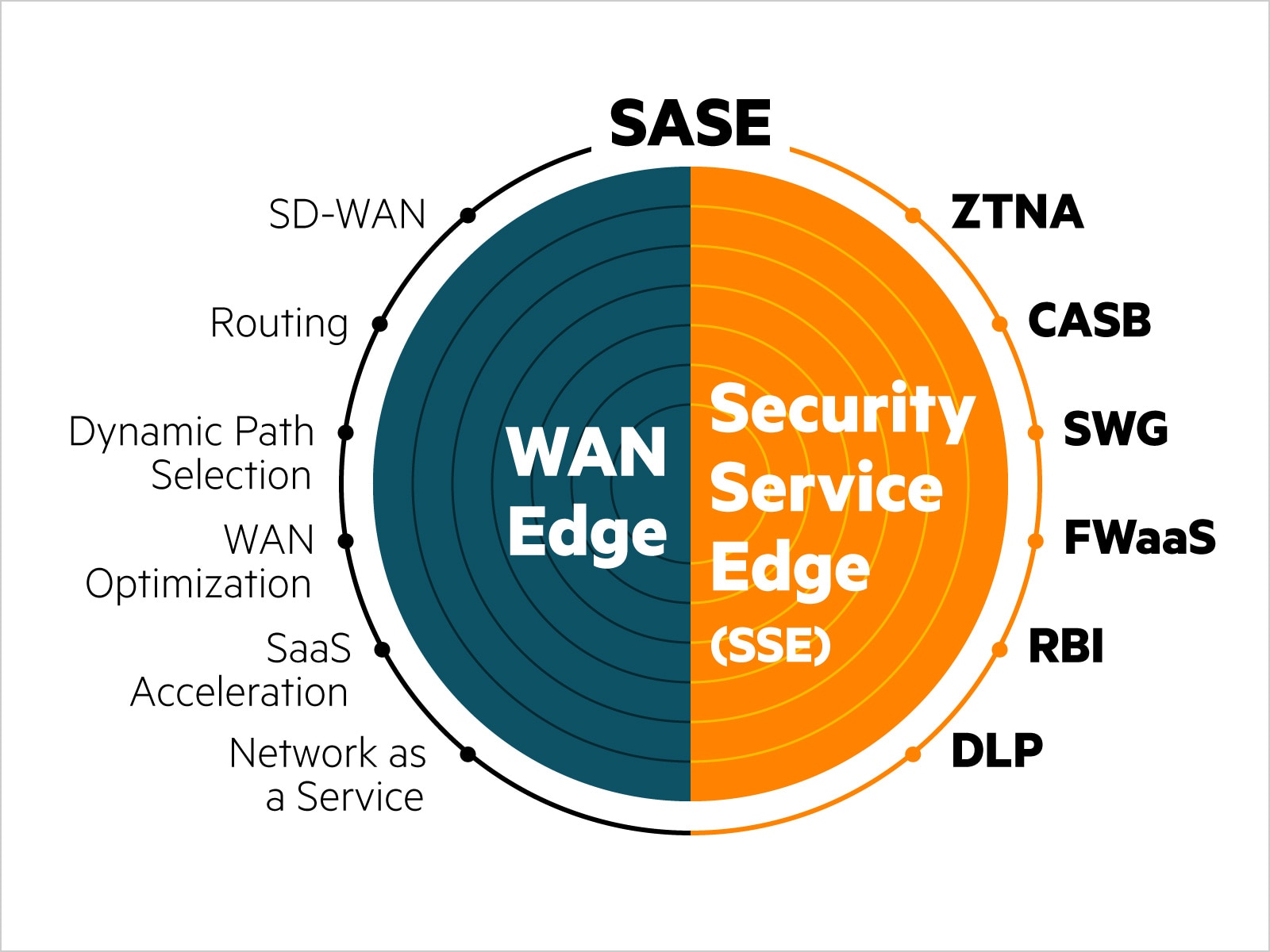
Security Service Edge, or SSE, is the security component of SASE (Secure Access Service Edge) that secures access to the web, SaaS applications, and private applications. It includes advanced security capabilities such as Zero Trust Network Access (ZTNA), Secure Web Gateway (SWG), Cloud Access Security Broker (CASB), and Firewall as a Service (FWaaS).

- Security Service Edge (SSE) explained
- How does SSE work?
- Components of SSE
- What is the difference between SSE and SASE?
- Why should I consider SSE?
- What are the benefits of SSE?
- SSE as a foundation for Zero Trust security
- Why SSE is key to securing cloud-first organizations
- HPE and SSE
Security Service Edge (SSE) explained
With the emergence of hybrid work environments, users connect from anywhere and from any device, accessing business applications and sensitive data directly in the cloud. As the traditional security perimeter continues to dissolve, security functions must also move to the cloud. SSE enables organizations to apply consistent security from the cloud and secure access to applications spread across multiple clouds, data centers, and software-as-a-service applications. An SSE solution—when combined with an advanced SD-WAN—creates a Secure Access Service Edge (SASE) architecture that significantly improves end user Quality of Experience for cloud-hosted applications.
How does SSE work?
An SSE solution secures remote access to web, cloud services, and private applications.
Traditionally, enterprises centrally hosted their applications in data centers, facilitating a variety of security inspections such as firewall and IDS/IPS. With applications moving to the cloud and remote working initiatives, enterprises now struggle to protect their applications from external threats as they operate in distributed environments outside the traditional security perimeter. Legacy network infrastructures prevent IT departments from monitoring all connections between users and SaaS applications. Additionally, directing cloud-destined traffic to the data center for security inspection significantly—and negatively—impacts application performance and user experience.
Security Service Edge solutions are cloud-delivered services that enable organizations to perform advanced security inspections closer to endpoints, including users and devices. It creates a dynamic security perimeter that provides threat protection, data security, security monitoring, and access control regardless from where users connect.
Components of SSE
Security Service Edge (SSE) includes four core security components:
- ZTNA assumes that by default, no user can be trusted to access anything until proven otherwise. Unlike a VPN that gives connected users broad access to the corporate network, ZTNA limits user access, via a trust broker, to only specific applications or microsegments that have been approved for the user.
- CASB identifies and detects sensitive data in cloud applications, including cloud-to-cloud access, and enforces security policies such as authentication and Single Sign On (SSO). It prevents users from signing up for and using cloud applications that are not authorized by an organization’s IT and security policies. This allows organizations to reduce shadow IT that causes security and compliance issues.
- SWG protects organizations from web-based threats using several defense techniques. It sits between a user and a website so that users connect to the SWG solution, which performs several security inspections including URL filtering, malicious code detection, and web access control and then redirects the traffic to the website.
- FWaaS is a cloud-based firewall that analyzes traffic from multiple sources. FWaaS consolidates traffic from multiple locations operated by the organization, including corporate headquarters, remote branch offices, and mobile users. FWaaS often supports critical access controls like IDS/IPS, advanced threat prevention, URL filtering, and DNS security.
- Other security services in addition to the core capabilities above can be offered such as Data Loss Prevention (DLP), Remote Browser Isolation (RBI), and sandboxing.
What is the difference between SSE and SASE?
SSE focuses purely on cloud-delivered security services. It secures user access to applications, internet and data. SASE combines both networking and security functions. It integrates SD-WAN for managing traffic with SSE into a consistent architecture, providing both connectivity and security, no matter where users or devices are located, enabling secure access and network performance at the edge.
Even though networking and security are closely interrelated, they remain two different and very complex domains of expertise. Security evolves rapidly to ensure protection against ever changing cybersecurity risks, while wide area networking (WAN) is about providing fast, robust, and flexible connections. SASE can help simplify and integrate these traditional and separate domains by offering consistent security, optimized performance, scalability and flexibility. By merging these two complex fields into a cohesive service, SASE reduces the need for deep expertise in both areas while delivering better security and performance.
Why should I consider SSE?
- SSE provides secure remote access. As hybrid working is the new norm, enterprises must secure their remote workers so that they can connect from anywhere. SSE offers Zero Trust capabilities that assume no user can be trusted by default. Based on identification, users can access certain parts of the network and see cloud applications that are relevant to their role in the organization only, preventing them from accessing and exploiting sensitive corporate data.
- SSE protects cloud-first organizations from external threats. With the acceleration of digitization, cybercrime has grown at the same rate. As most of the applications have moved to the cloud, organizations must now find effective ways to protect their digital assets. SSE provides firewall capabilities and protects organizations from web-based threats using several techniques such as URL filtering and malicious code detection. Thanks to its CASB features, it protects sensitive data hosted in the cloud by enforcing security policies. Other security features, such as Remote Browser Isolation (RBI), isolate web users from the internet by rebuilding web pages free from malicious codes.
- SSE and SD-WAN help build SASE with no compromise. Organizations should make no compromise with their security, that’s why they should have the freedom to choose between these two options for their security requirements. The first option is a unified SASE platform provided by a single vendor. The solution combines advanced SD-WAN capabilities with SSE functionalities. It offers a unified integrated approach, allowing for rapid deployment and simplified management. The second option is a multi-vendor solution where enterprise can select an advanced SD-WAN platform that tightly integrates with multiple cloud-security vendors and simplifies connectivity from the SD-WAN platform, giving the flexibility to select cloud-security vendors to address specific needs.
What are the benefits of SSE?
- Improved security. SSE brings security closer to the user and enables a more flexible approach toward connectivity outside the enterprise walls. Hosted in the cloud, SSE is easily updated to address the latest security threats, and policy changes can be immediately and automatically pushed to remote users, providing a consistent security approach.
- Simplified operations. SSE unifies several security services into one single platform, eliminating overlaps and leveraging the benefits of a single platform by deduplicating and harmonizing security policies. It provides greater visibility into security incidents from a central location, and it helps streamline operations and reduce costs.
- Secure access. SSE enables hybrid working by providing secure access to applications from anywhere and from any device, based on least-privilege access principles. Additionally, SSE safeguards employees from malicious web traffic and ensure corporate sensitive data remains protected. When paired with SD-WAN, employees in branch offices seamlessly and securely connect to the enterprise network or to the cloud.
SSE as a foundation for Zero Trust security
SSE plays a critical role in helping organizations implement a Zero Trust security model. By enforcing strict access controls and continuously verifying the identity and context of users, SSE ensures that only authorized users and devices can access specific applications or resources. Unlike traditional perimeter-based security models that assume everything inside the network is trusted, SSE enforces least-privilege access, reducing the attack surface and minimizing the risk of lateral movement within the network. This makes SSE an essential building block for organizations looking to modernize their security posture in the face of rising cyber threats and hybrid work environments.
Why SSE is key to securing cloud-first organizations
As more businesses adopt cloud-first strategies and migrate critical workloads to SaaS platforms and multi-cloud environments, the need for consistent, cloud-delivered security becomes paramount. SSE provides this protection by securing access to the internet, private applications, and cloud services—regardless of user location. With capabilities such as SWG, CASB, and FWaaS integrated into a unified platform, SSE simplifies security management and ensures consistent policy enforcement across distributed environments. Organizations benefit from enhanced threat protection, reduced complexity, and improved visibility, making SSE an essential component for securing the modern enterprise.
HPE and SSE
HPE Aruba Networking SSE sets a new benchmark for securing modern enterprises with a fully integrated, cloud-native solution that simplifies Zero Trust implementation. Unlike fragmented security tools, HPE Aruba Networking SSE combines ZTNA, SWG, CASB and DLP into a single platform with one management interface.
With agent-based and agentless ZTNA, users and third parties can securely access private and cloud resources from anywhere. SWG protects against web-based threats with URL filtering and SSL inspection, while CASB and DLP prevent data loss across SaaS applications.
Backed by a global cloud backbone across AWS, Microsoft Azure, and Google Cloud, HPE Aruba Networking SSE delivers consistent, high-performance access and security worldwide. Whether securing remote users, contractors, or branch locations, HPE Aruba Networking SSE enables organizations to apply Zero Trust principles everywhere—streamlining access, protecting data, and improving user experience from a single, unified solution.